Several years in the making

As Monsanto launched the first commercial biotech products in 1995, the industry changed rapidly, integrating more investment into every seed purchase. Consolidation of seed and ag-chemical companies became common, with Monsanto among the leaders. After a failed 1998 attempt to acquire the Delta and Pine Land Company, a successful bid was tendered in 2006 and the acquisition was completed in June 2007.
During the evaluation of that $1.5 billion purchase — focused primarily on cotton seed — its impact on Black farmers rose to prominence. Rather than answer allegations with a media campaign, the company chose to identify Black row-crop farmers who could advise on the acquisition and the other issues facing their operations. Soliciting help from the late Pearlie Reed, a well-respected fixture in the Black agricultural community, Dr. Dewayne Goldmon — then a Cotton Product Manager at Monsanto — led the effort to find growers who could serve that purpose.
A movement, in milestones
A pivotal acquisition
Monsanto tenders a successful bid for the Delta and Pine Land Company; the $1.5 billion, cotton-seed-focused purchase closes in June 2007, raising questions about its impact on Black farmers.
Eighteen months of listening
Pearlie Reed and Dr. Dewayne Goldmon hold personal conversations with Black row-crop farmers across the Southeast to shape a forward-focused agenda.
Eleven farmers meet
An initial meeting convenes at Monsanto world headquarters — product briefings and a reception on day one, the farmers’ own stories on day two.
NBCG is formailized
The group commits to independence, names itself the National Black Growers Council, and adopts its mission.
Incorporated
NBGC is formally incorporated, with two initial classes of membership and ten of the eleven founders as its first Board of Directors.
The initial meeting
With most Black row-crop farmers operating in the southeastern U.S., Reed and Goldmon spent eighteen months in personal conversations with area farmers who might serve on an advisory board. The agenda was deliberately forward-looking: the Black farmer class-action lawsuit would not be discussed, so the group could focus on strategies for the future.
On the first day, Monsanto managers covered product overviews, pricing, technology development, grower-support programs, talent acquisition, and farm-finance options. That evening the farmers joined Monsanto executives — the CEO, executive vice presidents, business managers, and leaders of the African Americans in Monsanto (AAIM) resource group — for a reception and dinner. On the second day, the scene shifted: the executives listened as these multigenerational producers shared the rich history of their operations — their struggles, their triumphs, and a shared passion for row-crop farming.
Although most of the eleven growers had never met, they quickly recognized how much they shared. Somewhere between the first and second day, the farmers — and key people at Monsanto — began to see their collective potential, concluding that an independent organization would better serve Black row-crop farmers across the nation. In a roundtable intentionally scheduled for day two, they mapped actionable ways to improve technology adoption, strengthen relationships with local representatives, support youth and young farmers, and reach other Black farmers.
In their own words
After choosing independence, the group named themselves the National Black Growers Council — to serve agronomic-crop farmers who make, or want to make, their living by farming. They set a clear mission:
To improve the efficiency, productivity, and sustainability of Black row-crop farmers.
The priorities they set
Actionable commitments the founders adopted for the work ahead.
- Improve grower relationships and build networks
- Maintain or increase Black farmers and Black-owned land
- Provide input on agricultural policy development
- Identify resources across the ag sector — companies, foundations, USDA, and checkoff funds
- Improve grower relationships and build networks
- Maintain or increase Black farmers and Black-owned land
- Provide input on agricultural policy development
Formalized, then incorporated
NBGC was formalized in 2009 and incorporated in 2010. From the start it has collaborated with the Congressional Black Caucus, land-grant institutions, USDA agencies, agricultural companies, other commodity groups, and community-based organizations.
Congressional Black Caucus
Land-grant institutions
USDA agencies
Agricultural companies
Commodity groups
Community-based organizations
Classes of membership
Regular
For Black row-crop farmers — the heart of the Council.
Sustaining
For companies and organizations that support the group.
Supporting
Added later — for individuals and organizations aligned with NBGC’s mission.
THE FOUNDING BOARD
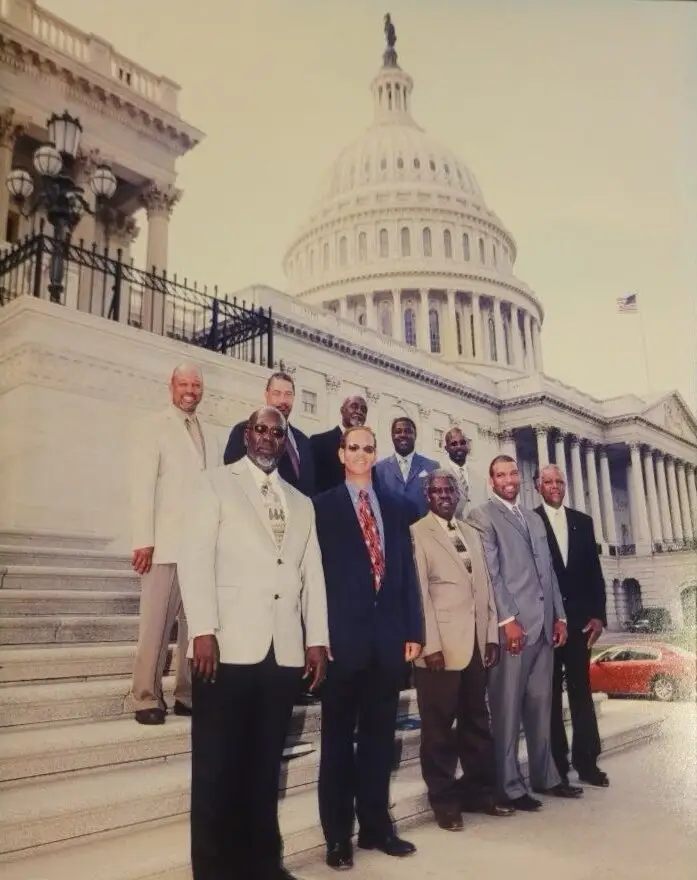
The charter members
Ten of the eleven farmers who attended the initial meeting served as the founding incorporators and first Board of Directors — a group offering broad geographic representation and diverse experience in the crops they grew and the issues they faced.
Harper Armstrong
ARMSTRONG FARMS
Bastrop, LS
Bill Bridgeforth
Darden Bridgeforth & Sons
Tanner, AL
Melvin Crum
Crum Farms
Rowesville, SC
Dexter Gilbert
Gilbert & Sons Farms
Campbellton, FL
Haywood Harrell
Harrell Farms
Halifax, NC
Philip (PJ) Haynie III
Haynie Farms
Bobby Holmes
Bobby Holmes Farm
Marianna, AR
J.D. Jacobs
Rockwall, TX
Tanner, AL
Rogers Morris
Morris Farms
Mound Bayou, MS
Mike Patterson
Patterson Farms
Leland, MS
Ray Sneed
Sneed Farms
Drummonds, TN
